Figure 1. A selfie with my wife, taken right where I was born.
Trying to tell your own story is tricky business. I’ve been on the Northwestern University faculty for nearly 20 years, and for about 25 years my research has revolved around modeling and analyzing nonlinear dynamics in complex systems and networks – an area that fascinates me and that keeps my curiosity alive every day. From the outside, that might sound like a carefully planned trajectory, but in truth, much of it was shaped by circumstance, opportunity, and the good fortune of crossing paths with the right collaborators. And, just as much, by the directions my path didn't take and the simple luck of having been born where and to whom I was.
In hindsight, my path has been somewhat unconventional. I was born and raised in a small rural town in Brazil, idyllic in many ways, but where the opportunities for education were extremely limited. So, when I was 15, I moved away from my parents’ home to complete high school in the state capital, some 350 miles away. That is when I had my first formal job, 6 hours/day as a receptionist, so I could afford a private school. This might have been the most consequential decision I made in my life. Brazil has an educational paradox: the best universities are public and free, but only those who can afford private schooling are well prepared to enter them – an issue that has improved but not disappeared.
The new school felt like a different universe – the pace, the expectations, even the way people spoke. My initial struggle with the staggering difference was real, but I eventually turned things around and made it to the top of my class. That change put me within striking distance of entering any public program at the end of high school. I chose UNICAMP, a leading state university in São Paulo, where I completed both my undergraduate and graduate studies under the guidance of two fantastic mentors.
I had never planned to become a researcher. Medicine was my main interest growing up, and it stayed that way until one of my sisters, a physical therapy student, brought me to an anatomy class. But in retrospect, I might have been born a scientist. From my earliest memories, I remember being deeply bothered by dogmas that seem to defy evidence. That may have been what led me to pursue physics as an undergraduate and then, after developing an interest in the math behind it, applied mathematics in graduate school. Another influence might have been that my father, a farmer, was exceptionally good at mental math, and this made numbers feel like a comfort zone. Still, it wasn’t until well into my Ph.D. that I convinced myself that I could really make a career out of just doing research. (Eventually, I also developed a passion for teaching and mentoring, though that came a bit later.)
Toward the end of my Ph.D., I visited Arizona State University. During that visit, my ASU mentor kindly arranged for me to attend the 2001 SIAM DS conference, where I heard Steven Strogatz give a talk on small-world networks. That talk had a profound influence on me. At the time, I was interested in the dynamics of high-dimensional systems, and suddenly I realized that I could instead approach them as a network of weakly coupled low-dimensional ones. This realization helped me think more creatively about how to model emergent behavior in a range of complex systems, well beyond the specific problem I was considering then. I carried that perspective into my postdoctoral years as an independent researcher at the Max Planck Institute for the Physics of Complex Systems and the Center for Nonlinear Studies at Los Alamos National Laboratory.
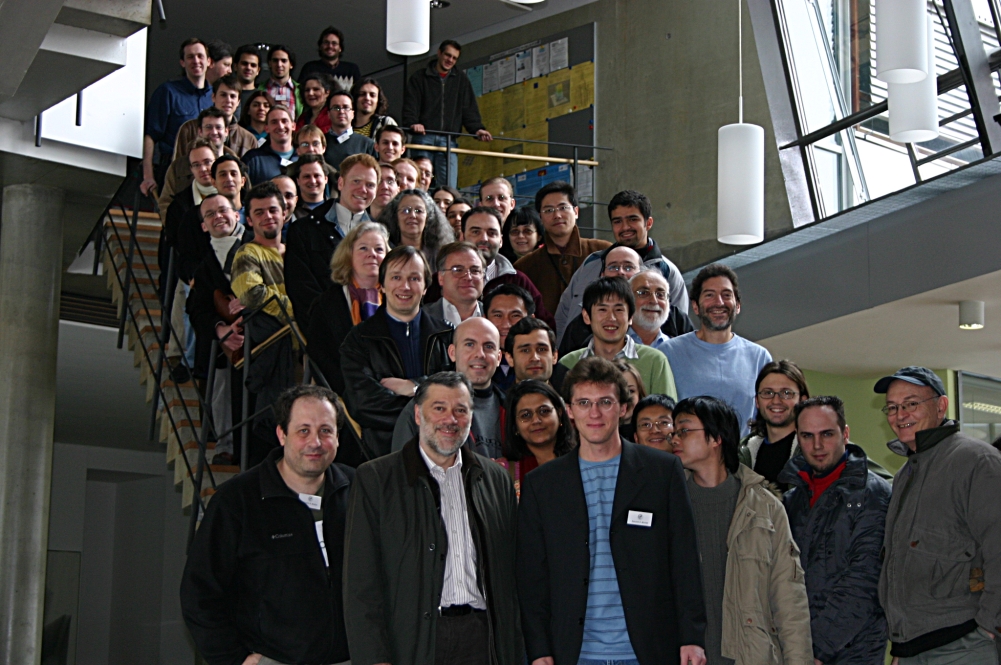
Figure 2. With the other organizers (front left) and some of the attendees of the International Workshop and Seminar "Dynamics on Complex Networks and Applications," MPIPKS, Dresden (2006).
I really enjoyed my time at each of these institutions and valued the chance to experience research in three different countries. Although most of my career had been in academia, I found it gratifying to work in a government lab. Given the prospect of a permanent staff position, staying at LANL would have been an excellent professional choice. However, partly because of a developing two-body problem, the Chicago area became a natural destination. As luck would have it, that year Northwestern had a search in complex systems, and it was still open when I started applying for jobs after Christmas.
The result is arguably uncommon: I have graduate training in applied math from a developing country, and I now hold a primary appointment in a Physics and Astronomy program at an R1 university. I certainly didn’t plan that, but it’s a testament to how much more interconnected and interdisciplinary the world has become.
Figure 3. Simulations of a microfluidic channel with obstacles that generate nonlinearities analogous to those observed in porous materials, from our publication: D. J. Case et al., Nature 574, 647 (2019).
This interdisciplinarity is reflected in the Center for Network Dynamics, which I have the privilege of directing. There, my colleagues and I explore how new systems and behaviors can arise from interactions between existing ones. One example involves microfluidic networks that exhibit tunable spontaneous oscillations, negative conductance, the Braess paradox, and other programmable behaviors – all generated by inertial effects harnessed through carefully designed interactions among system components.
Arguably, the best part of being a university professor is the chance to interact constantly with creative students, postdocs, and colleagues. Much of my success and satisfaction as a researcher comes from the opportunities I’ve had and continue to have to mentor and collaborate with so many talented people.