The SIAM Activity Group on Dynamical Systems came together in Denver, Colorado from May 11–15, 2025 for their bi-annual conference, building community, sharing research, and providing an opportunity for folks to see friends and make new connections to span decades of DS conferences to come. The conference featured an icebreaker geared toward first-time attendees, a welcome reception and Spectra community meetup, a lunch-time mentoring session, nine plenary talks, one prize lecture, two minitutorials, a large poster session, a panel on the future of interdisciplinary research in dynamical systems, meetings of the SIADS and DSWeb boards, and an activity group business meeting. The scientific program also had over 233 minisymposium sessions and 31 contributed sessions, with topics spanning the broad range of applied dynamical systems research.
The poster session (and associated Red Sock Award) was a highlight of DS25, and the judging committee selected four winning presentations from nearly 100 posters:
- Twinkle Jaswal (Illinois State University, “Photosensitivity and neuronal synchronization”)
- Juan Patiño Echeverria (University of Auckland, “Into the wild: a journey to chaos in four dimensions”)
- Laura Pinkney (University of Leeds, “Pattern formation driven by three-wave interactions with two critical wavenumbers”)
- Anna K. Thomas (University of Pittsburgh, “Cellular and Parkinsonian network dynamics in a conductance-based model of the pedunculopontine nucleus in rodents”)
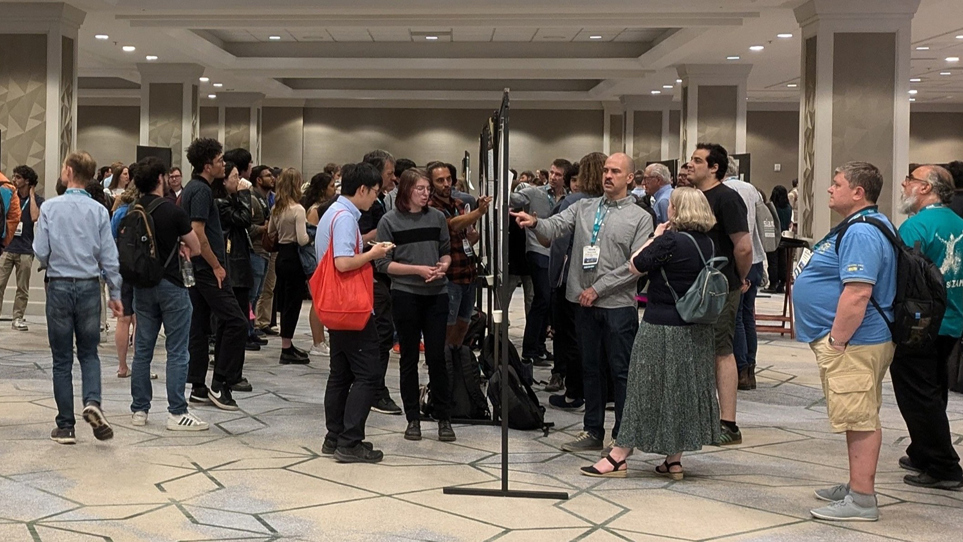
Figure 1. The poster session and dessert reception promoted spirited discussions about a wide variety of research applications. Throughout the evening event, roving judges evaluated the presentations of students and postdoctoral researchers to select the winners of the Red Sock Award, who were announced the next day. Photo courtesy of SIAM.
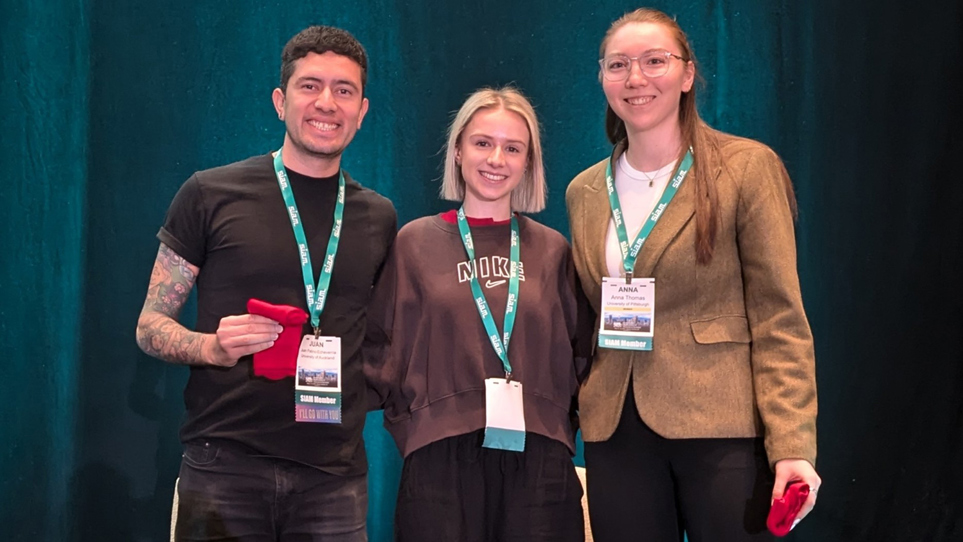
Figure 2. The illustrious Red Sock Award recognized outstanding poster presentations by students and postdoctoral researchers. From left to right: awardees Juan Patiño-Echeverria of the University of Auckland, Laura Pinkney of the University of Leeds, and Anna Thomas of the University of Pittsburgh hold the coveted accessories for which the prize is named. Recipient Twinkle Jaswal of Illinois State University is not pictured. Photo courtesy of SIAM.
We congratulate these students and postdocs for receiving the Red Sock Award, which is named in honor of James A. Yorke, for their excellent posters and exciting research! We are also particularly grateful to Stephanie Dodson and Heather Zinn Brooks for leading the organization of poster judging, and to all of those who served as poster judges at DS25:
- Montie Avery (Boston University)
- Jason Bramburger (Concordia University)
- Philip Chodrow (Middlebury College)
- Olivia Clifton (Cannon) (University of Illinois Urbana-Champaign)
- Daniel Cooney (University of Illinois Urbana-Champaign)
- Jennifer Crodelle (Middlebury College)
- Björn de Rijk (Karlsruhe Institute of Technology)
- Timothy Faver (Kennesaw State University)
- Punit Gandhi (Virginia Commonwealth University)
- Indranil Ghosh (Massey University)
- Dan Hill (Oxford University)
- Matt Holzer (George Mason University)
- Gabriella Jaramillo (University of Houston)
- Nour Khoudari (Purdue University)
- Timothy Lewis (University of California, Davis)
- Kevin Lin (University of Arizona)
- Anna Nelson (University of New Mexico)
- Ross Parker (IDA)
- Timothy Roberts (University of Chicago)
- Leah Shaw (College of William & Mary)
- Laura Storch (Bates College)
- Frits Veerman (Leiden University)
- Yangyang Wang (Brandeis University)
- Jasper Weinburd (University of St. Thomas)
The winners of the 2024 DSWeb “Tutorials on Dynamical Systems” Software Contest were also announced at DS25. Two prizes were awarded. Roy Goodman (New Jersey Institute of Technology), Gracie Conte and Jeremy Marzuola (University of North Carolina) won for “QGLAB, a MATLAB Package for Solving PDEs Posed on Quantum Graphs”. Matteo Martin (University of Padua) and Anna Thomas (University of Pittsburgh) won for “XPPLORE: Import, Analyze, and Visualize XPPAUT Data in MATLAB”. We thank Korana Burke (UC Davis) for organizing the contest.
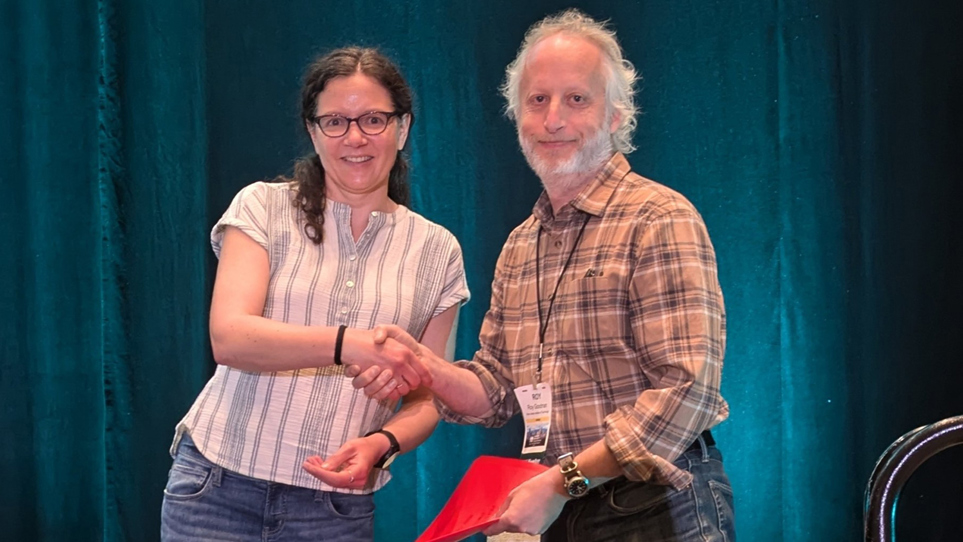
Figure 3. Roy Goodman of the New Jersey Institute of Technology (right) receives the DSWeb Tutorial Contest Award from DSWeb education/teaching section chief editor Korana Burke of the University of California, Davis. The prize acknowledges Goodman’s development of a beneficial software tutorial that assists computational dynamical systems researchers. Photo courtesy of SIAM.
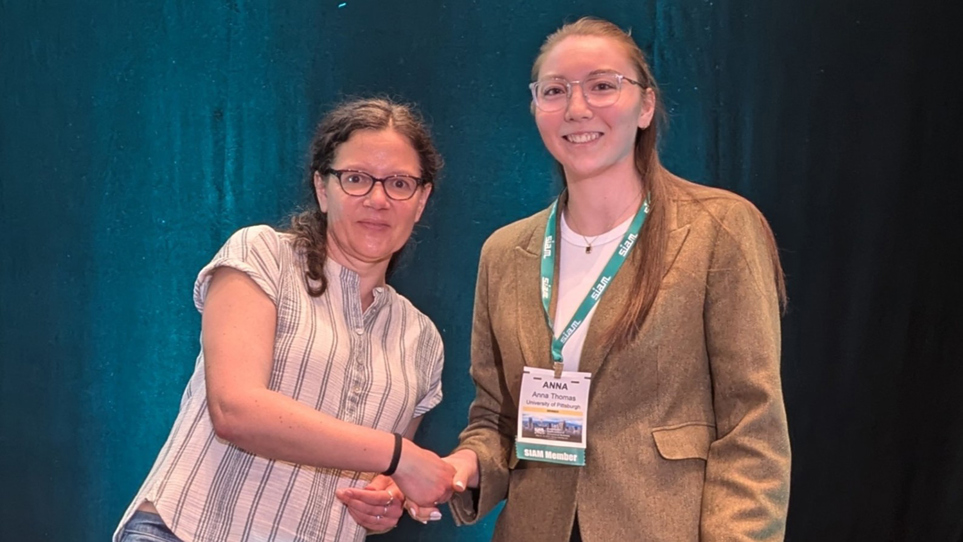
Figure 4. Anna Thomas of the University of Pittsburgh (right) accepts the DSWeb Tutorial Context Award from DSWeb education/teaching section chief editor Korana Burke of the University of California, Davis. The prize recognizes the creation of useful computational resources that promote novel and creative software-based methods in deterministic and stochastic dynamical systems. Thomas was honored alongside Matteo Martin of the University of Padua (not pictured) for their joint development of the XPPLORE toolbox, which automates the analysis of output from the XPPAUT dynamical systems software. Photo courtesy of SIAM.
Following the tradition that started with DS17, DS25 kicked off with a structured icebreaker to welcome first-time attendees to our community. We’re grateful to the icebreaker organizers—organizing committee members Daniel A. Cruz and Nancy Rodriguez—for putting together this engaging session, warmly welcoming folks as they arrived, and providing many tips about visiting Denver and participating in DS conferences. The room was buzzing as folks played icebreaker bingo and introduced themselves to one another. We also thank SIAM for providing prizes for this event in the form of SIAM swag and books. Following this icebreaker, there was a larger welcome reception and Spectra community meetup in the main room of the conference venue, and we were delighted to see many people there.
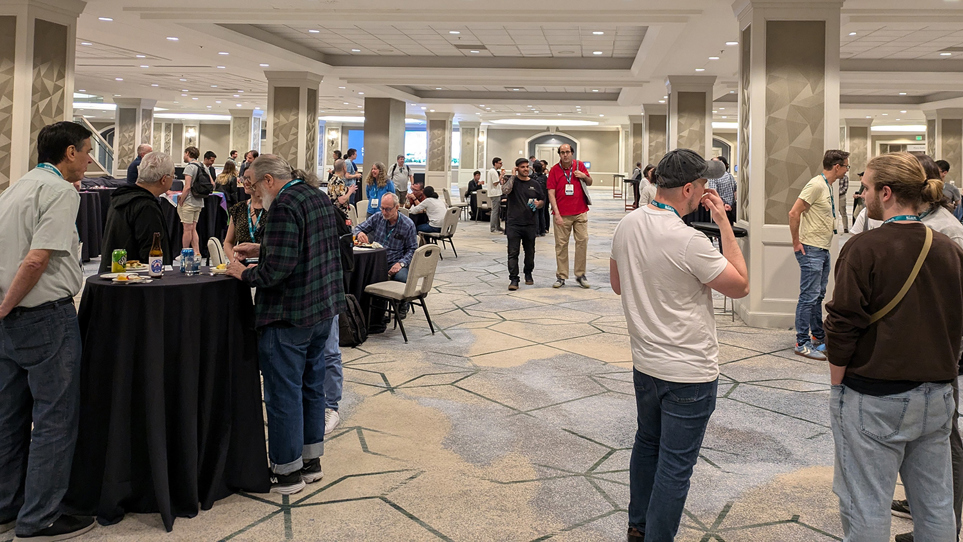
Figure 5. A lively welcome reception introduced attendees to the epicenter of activities in Denver and provided an opportunity for conversations between longtime colleagues and new acquaintances alike. Spectra, the LGBTQ+ affinity group for mathematicians, also held an informal community gathering during the reception. Photo courtesy of SIAM.
As another means of creating community across career stages, there was a lunch-time mentorship session at DS25 organized by several members of the organizing committee: Maximilian Engel, John H. Lagergren, and Niall M. Mangan. Participants completed a survey ahead of time to indicate their main topics of interest, and then the session featured small-group discussions on teaching, thriving at various career stages, applying to industry and national-lab positions, contending burnout, balancing different commitments, and other topics. This was an active event full of questions from mentees, and we’re grateful to all of those who volunteered to serve as mentors.
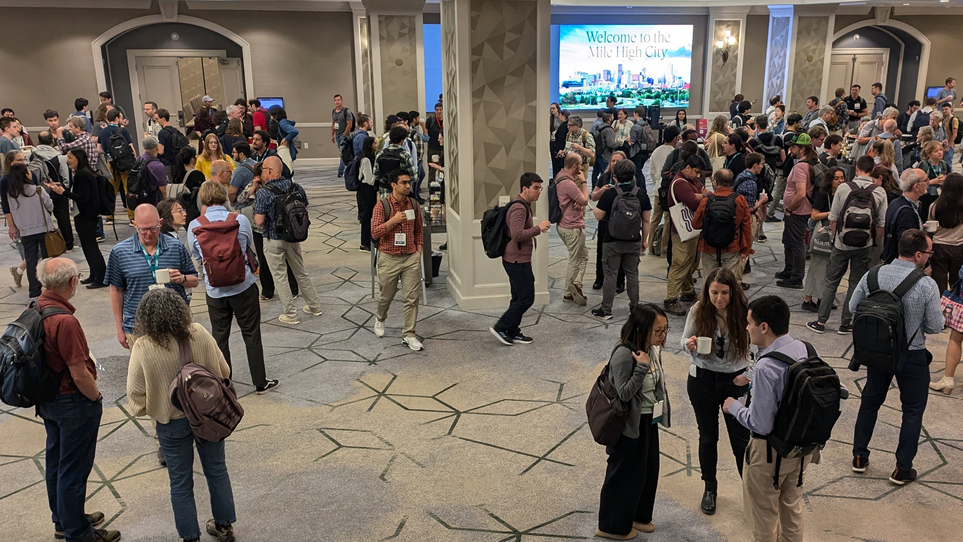
Figure 6. Throughout the 2025 SIAM Conference on Applications of Dynamical Systems, twice-daily coffee breaks provided attendees with opportunities for scientific and sociable conversations between sessions. Photo courtesy of SIAM.
DS25 continued the DS tradition of excellent talks by all of its plenary speakers. Topics spanned tipping points in non-autonomous systems (Peter Ashwin, University of Exeter); multiple modeling perspectives on locust self-organization (Andrew J. Bernoff, Harvey Mudd College); network dynamics and coupled oscillators (Christian Bick, Vrije Universiteit Amsterdam); spectral representations and inference for complex biological systems (Jörn Dunkel, MIT); multiplicative ergodic theory and random dynamical systems (Cecilia Gonzalez Tokman, University of Queensland); multiscale modeling to shed light on drug-treatment strategies for cancer (Trachette Jackson, University of Michigan); advice on writing reproducible, validated, usable code (Tamara G. Kolda, MathSci.ai); data-driven methods for model identification (J. Nathan Kutz, University of Washington); and persistent homology as a means to detect changes in dynamical systems (Elizabeth Munch, Michigan State University). Slides from Tamara Kolda’s talk, providing many useful resources on best practices for writing and storing software, are available here.
We also had an opportunity on the first full day of DS25 to see Gary Froyland (University of New South Wales Sydney) receive the J. D. Crawford Prize. And, after a fun audience-participation based introduction from our SIAG chair Jon Rubin, Bard Ermentrout gave the Jürgen Moser lecture on oscillatory systems in biology and neuroscience.
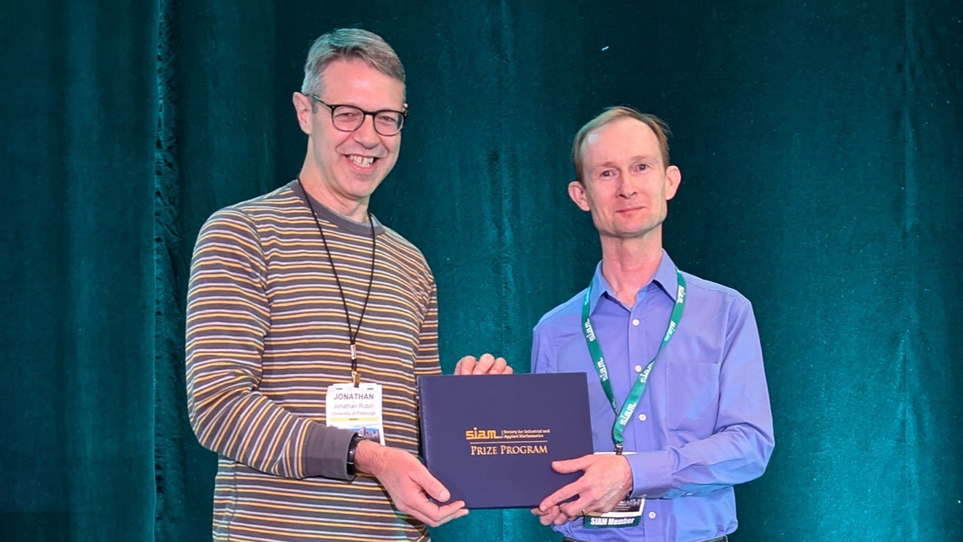
Figure 7. Gary Froyland of the University of New South Wales (right) accepts the 2025 J.D. Crawford Prize from Jonathan Rubin of the University of Pittsburgh, chair of the SIAM Activity Group on Dynamical Systems. The J.D. Crawford Prize honors researchers for recent outstanding contributions to a topic in nonlinear science; Gary was recognized for his work on the spectral analysis of climate dynamics via operator-theoretic approaches that advance the theory of complex fluid flow. Photo courtesy of SIAM.
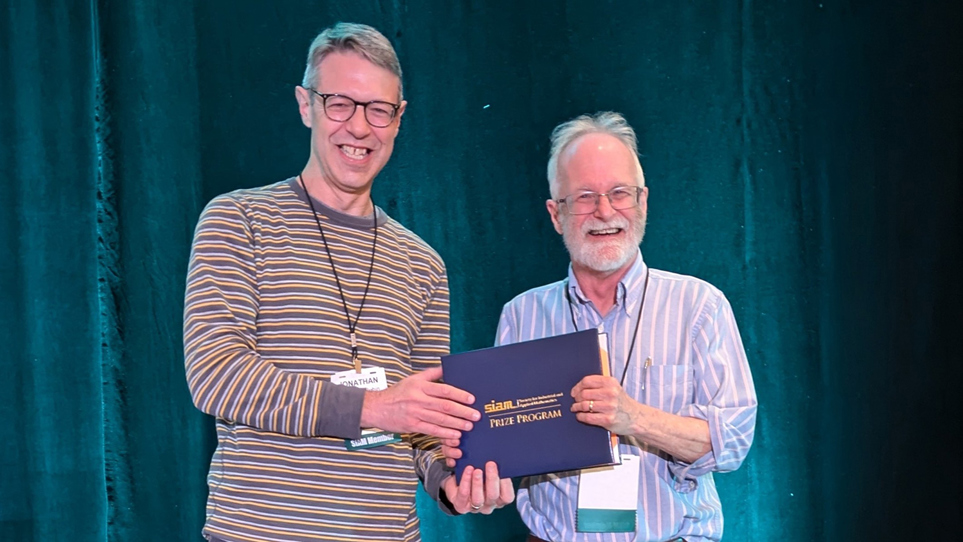
Figure 8. Jonathan Rubin of the University of Pittsburgh (left), chair of the SIAM Activity Group on Dynamical Systems, congratulates Bard Ermentrout of the University of Pittsburgh for his receipt and delivery of the Jürgen Moser Lecture. Bard was honored for his "broad and seminal contributions to mathematical biology, including pioneering work on mathematical and computational neuroscience, dynamical systems, and pattern formation." His accompanying lecture was titled "Not Just Another Pretty Phase: The Use of Phase Models in Neuroscience and Biology." Photo courtesy of SIAM.
There were several other special events at DS25, including a panel on interdisciplinary research related to dynamical systems (moderated by Cecilia Diniz Behn and Igor Belykh, and featuring Daniel M. Abrams, Chris Budd, Dorit Hammerling, Mari Kawakatsu, and Jonathan E. Rubin as panelists); a minitutorial on nonlinear spectral reduction (organized by George Haller, Shobhit Jain, and Bálint Kaszás); a minitutorial on higher-order networks (organized by Laurent Hébert-Dufresne and Nicholas Landry); and, associated with DS25, a satellite conference on stochastic operators at the Colorado School of Mines. Google Colab and GitHub repository resources for the network session are available from the links here. Thank you to all of those who organized, spoke in, or participated in these special events!
Lastly, we want to thank our conference organizing committee members:
and—most especially—we gratefully acknowledge the SIAM staff. From meeting with us two years before DS25 and shepherding us through the scientific organization process (via many emails with our main point-person, Kirsten Wilden) to writing up articles about DS research in real time (some of Jillian Kunze’s articles covering DS25 are here, here, here, and here) and making sure all of the conference logistics ran smoothly (and even formatting this writeup for posting on DSWeb—thank you, James Haines), the SIAM team is stellar.
Whether your first DS conference was DS25 or many years ago, thank you to the DS community for making our bi-annual get-together continue to be an event where students and postdocs meet mentors that they’ll have throughout their careers, participants celebrate accomplishments and prizes, and folks see friends and collaborators. Continuing prior trends, DS25 reported record registration of 1000+ participants for Denver’s conference, and we look forward to seeing an even larger community at SIAM DS27!